As an Amazon Associate, we earn from qualifying purchases. Some links on this site are affiliate links at no extra cost to you. Our recommendations are based on thorough research and editorial judgment.


The Role of Compressors Vs Thermistors in Cooling Appliances

In cooling appliances, compressors and thermistors serve important but different functions. Compressors compress refrigerant gas to create cooling, operating on 115VAC and consuming significant power during start-up. They maintain temperatures effectively but require regular maintenance to prevent leaks. Thermistors, on the other hand, are temperature-sensitive resistors. They quickly adjust temperatures, enhancing energy efficiency by up to 30%. Their compact size allows for placement in portable devices, ensuring fizzy drinks stay crisp. There’s more to explore about how these components impact your appliances.
Key Takeaways
- Compressors are essential for raising refrigerant pressure and temperature, enabling effective cooling in refrigerators and air conditioners.
- Thermistors provide accurate temperature measurements, allowing for precise control over cooling conditions, enhancing energy efficiency.
- Regular maintenance is crucial for compressors to prevent leaks and maximize lifespan, while thermoelectric coolers require less maintenance due to their solid-state design.
- Compressors often produce noticeable noise levels, ranging from 40 to 70 decibels, while thermoelectric systems operate almost silently.
- The integration of thermistors with advanced compressor technologies results in reduced energy consumption and improved overall performance of cooling appliances.
Understanding Compressors in Cooling Systems
Compressors are essential in cooling systems, such as refrigerators and air conditioners. They work by compressing refrigerant gas, raising its pressure and temperature. This process helps maintain temperature control within our appliances by cycling the refrigerant through evaporator and condenser coils. Compressor-based systems, while energy-efficient, can have high power consumption, especially during start-up. Typically, they operate on 115VAC and may draw considerable current during their on-off cycles. Proper maintenance is vital to avoid issues like refrigerant leakage, which impacts performance and reliability. Regular servicing can enhance the efficiency of these systems and prolong their lifespan. Overall, a well-maintained compressor is key to an effective cooling system, ensuring we enjoy icy drinks and cool air without worry. The efficiency of a compressor can notably affect maximum juice extraction when utilizing appliances like heavy-duty lemon squeezers.
The Function of Thermistors in Temperature Regulation

When it comes to maintaining the right temperature in our cooling appliances, thermistors play an essential role. They’re temperature-sensitive resistors, ideal for accurate temperature measurement and temperature control. With a negative temperature coefficient, their resistance decreases as temperature increases, enhancing response time. This allows cooling appliances like refrigerators and air conditioners to adjust swiftly, creating a comfy environment and improving energy efficiency. They can respond in milliseconds to real-time temperature changes. Their compact design makes them perfect for portable devices, fitting easily into tight spaces. In many cases, they help maintain crunchy snacks and fizzy drinks at the right temperature. Overall, thermistors are crucial in helping us achieve ideal performance in our cooling appliances. Energy-efficient operation significantly benefits from the precision offered by thermistors.
Recommended Products


New part # compatible with AP5953061 and ten more replacements for all new models

VERSATILE APPLICATIONS: This remote indoor temperature sensor has been specifically designed with versatility in mind, making it suitable for use across a wide range of applications.
How Compressors Create the Refrigeration Cycle

In order to maintain a consistently cool environment in our appliances, understanding the refrigeration cycle is crucial. The compressor cooling systems play a significant role in this process. It starts when the compressor draws in low-pressure refrigerant gas and compresses it into a high-pressure refrigerant. This compression raises the gas temperature, allowing for heat expulsion during condensation. The high-pressure refrigerant then flows through the condensers, releasing heat to the surroundings and transforming into a liquid state. Afterward, the liquid passes through an expansion valve, reducing its pressure and temperature before entering the evaporator. Here, it absorbs heat from the appliance’s interior, facilitating efficient temperature control and providing the necessary cooling power for our refrigeration needs. Many modern countertop ice makers also integrate efficient compressor systems, enhancing their cooling capabilities while maintaining energy efficiency.
Recommended Products

Designed using the highest quality materials and components to provide the user with colder product temperatures, lower utility costs, exceptional food safety and the best value
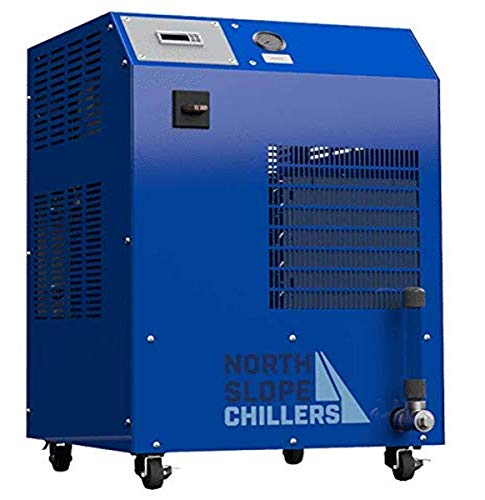
Freeze, North Slope's standard industrial chiller is an absolute workhorse

ENERGY EFFICIENT: Experience reduced energy consumption and lower operating costs with this high-performance lubricant designed for optimal efficiency.
The Importance of Thermistors for Energy Efficiency

Thermistors play an essential role in enhancing energy efficiency in cooling appliances. These temperature-sensitive resistors provide precise temperature control, allowing for better compressor operation. By enabling variable speeds instead of standard on-off cycling, thermistors help maintain ideal temperature ranges, leading to energy savings of up to 30%. Their quick response to temperature changes optimizes system performance, particularly during fluctuating ambient conditions. This efficiency minimizes energy consumption and lowers costs associated with cooling. When combined with advanced compressor technology, thermistors enhance overall system efficiency. This integration not only cuts energy usage but also reduces greenhouse gas emissions. Ultimately, investing in cooling appliances equipped with thermistors pays off through reduced bills and a healthier planet.
Additionally, many models of compact refrigerators are designed with energy-efficient features that complement the advantages of thermistors.
Recommended Products
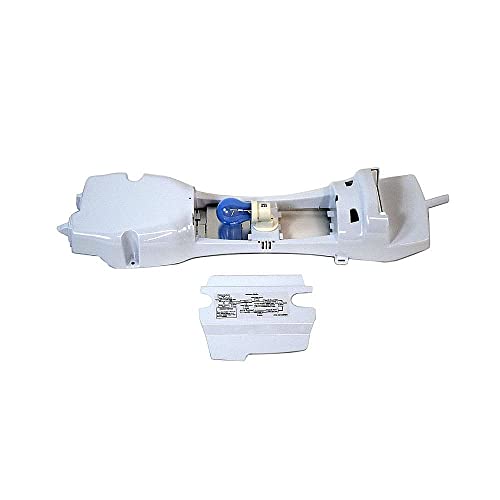
This part is compatible with models including; FFHT1514QW5,FFHT1514QS4,FFHT1514QW4,FFHT1514QB5,FFHT1514QB4,FFHT1514QS5

Update Remote Mute: Enjoy the convenience of dismissing the hub's beep directly from the Smart App, eliminating the need to manually press a button

Manufacturer Model 241608401
Comparing Efficiency: Compressors vs. Thermistors
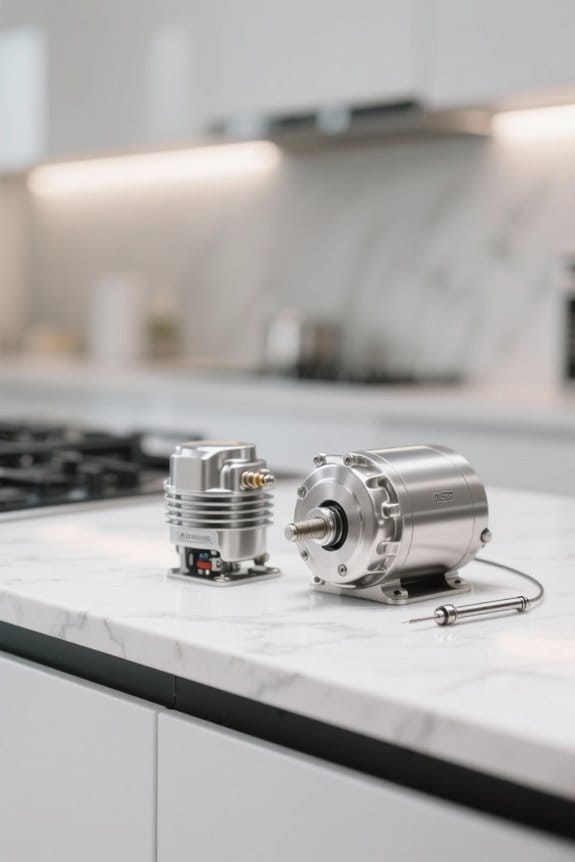
While both compressors and thermistors play significant roles in cooling appliances, their functions differ greatly in how they contribute to energy efficiency. Compressor systems excel at higher cooling loads, especially in large-scale applications where performance shines. Conversely, thermistors enhance energy efficiency by providing vital temperature control. In small-scale refrigeration, thermoelectric coolers powered by thermistors may outperform traditional compressors, especially at lower loads. They utilize the Peltier effect for effective heat dissipation. However, compressors can lose efficiency during short cycling. Implementing thermistors helps manage these cycles, reducing energy waste and improving overall operation. By ensuring compressors run only when necessary, thermistors optimize energy consumption, ultimately benefiting consumers by lowering energy bills while maintaining desired cooling performance. Additionally, many mini fridges, such as the EUHOMY Beverage Refrigerator Cooler, are designed to maximize energy efficiency through effective temperature management.
Impact on Maintenance and Longevity
When evaluating the impact on maintenance and longevity, it’s clear that compressor systems and thermoelectric coolers differ markedly. Compressor-based systems often need regular maintenance due to their moving parts and refrigerant management. This not only raises operational costs but increases the chance of mechanical failure over time. In contrast, thermoelectric coolers have a solid-state design with no moving parts, leading to higher reliability and low maintenance. Their lifespans average over 70,000 hours. Unlike compressors, they avoid concerns like refrigerant leakage, which simplifies servicing. Maintenance for compressors includes refrigerant checks and refills, making servicing more complex. As a result, thermoelectric systems experience less wear and tear, requiring fewer replacements and repairs, which enhances overall longevity. Additionally, many modern space-saving appliances utilize thermoelectric technology for efficient operation in compact areas.
Recommended Products

High quality interior for attractive look

Temperature Management: Elevate your wine storage with Kingchii's advanced dual-zone cooling system tailored for reds and whites. Customize temperatures for each bottle—upper zone (41-64°F) and lower zone (41-64°F)—to preserve your wine collection's flavors and aromas.

166 standard 750ml wine bottle capacity or 161 bottles (with display shelf) capacity; Built-In / Freestanding Installation; Reversible door swing
Noise Levels and User Experience
Noise from cooling systems can greatly impact our daily lives. Compressor-based units typically operate at noise levels between 40 to 70 decibels, which can be disruptive. In contrast, thermoelectric coolers deliver a silent operation, often close to 0 decibels. This is vital for preserving user experience in quiet settings, like homes or labs. While compressor units achieve energy efficiency, they don’t match the near-silent performance of thermoelectric systems. Additionally, thermoelectric coolers provide accurate temperature control without noticeable sound, enhancing user satisfaction. Studies show that consumers prefer appliances with lower noise emissions. As we weigh our options, we should consider how much noise matters in our personal or professional environments to guarantee we select the right cooling solution. The power and performance of these systems can play a crucial role in their noise levels.
Environmental Considerations in Cooling Solutions
As we consider various cooling solutions, it is essential to examine their environmental impact. Compressor coolers often use refrigerants with high global warming potential (GWP), raising concerns about their usage. In contrast, thermoelectric cooling systems, like thermoelectric coolers, don’t rely on these refrigerants, making them more environmentally friendly. They help protect the ozone layer. Recent developments in compressor technology include “green” refrigerants designed to lower environmental impacts and meet new regulations. While thermoelectric systems excel at low heat loads with lower energy consumption, compressor coolers can be more energy efficient for larger applications. Ultimately, choosing between these options shapes our carbon footprint and influences the sustainability of cooling solutions in our lives. Additionally, some ice makers feature ice production capacity that highlights their significant output and efficiency, impacting energy consumption positively.
Future Trends in Cooling Technology
While consumers may worry about the environmental impact of cooling technology, future innovations promise more efficient solutions. The shift towards energy efficiency is driving improved compressors with variable speed technology. These units optimize energy use based on cooling demands, ensuring up to 90% operational efficiencies with thermoelectric systems. Compact cooling systems will combine thermoelectric coolers and micro compressors in portable devices, meeting consumer needs for lightweight solutions. As we emphasize sustainability, expect the adoption of eco-friendly refrigerants in compressors, while thermoelectric systems continue to shine with their low environmental impact. Additionally, smart technologies will bring enhanced controls for precise temperature regulation, extending the lifespan of both compressor-based units and thermoelectric systems, creating a more efficient and sustainable cooling future. This aligns with the trend towards integrating user-friendly features that improve the overall consumer experience in home appliances.
Frequently Asked Questions
Which Is Better, a Thermoelectric or a Compressor?
When we weigh thermoelectric efficiency against compressor performance, it’s clear each has its strengths. For quiet, energy-efficient cooling, thermoelectric shines, but if we need robust cooling capacity and temperature control, compressors often prevail in reliability and performance.
What Is the Role of Compressor in Cooling System?
The compressor’s functionality boosts cooling efficiency by compressing refrigerants, yet it does increase energy consumption and noise levels. We must consider maintenance requirements and refrigerant types for ideal system longevity and performance comparison with alternatives.
Which Is Better Thermoelectric or Compressor Mini Fridge?
When weighing thermoelectric and compressor mini fridges, we should consider thermoelectric efficiency, compressor durability, size, energy consumption, noise levels, and cost. Ultimately, our choice depends on specific needs and desired cooling technology performance.
What Are the Four Main Functions of the Compressor in a Refrigeration System?
In the grand symphony of refrigeration, the compressor guarantees efficiency by managing refrigerant types, controlling temperature, minimizing noise levels, and influencing energy consumption—all while needing proper maintenance to reduce environmental impact and enhance system design.


